If you want to understand Malaysia without the glossy sheen of tourism campaigns, you have to sit down at a neighborhood kopitiam in Cheras or Petaling Jaya at seven on a weekday morning.
The air is thick with roasted Robusta beans, the humid exhaust of urban traffic, and the clatter of porcelain saucers. At the counter, an elderly Hainanese uncle slides a plate of butter-and-kaya toast across marble laminate. Two tables over, an Indian contractor orders a frothy glass of teh tarik with a quick “Boss, kurang manis ya,” while outside, the faint cadence of the morning call to prayer has just yielded to the hum of the morning commute. We call out orders in a rapid, seamless mash-up of Cantonese, Malay, and Hokkien, punctuated by English suffixes. “Dey, tapau satu, quickly ah, late already.”
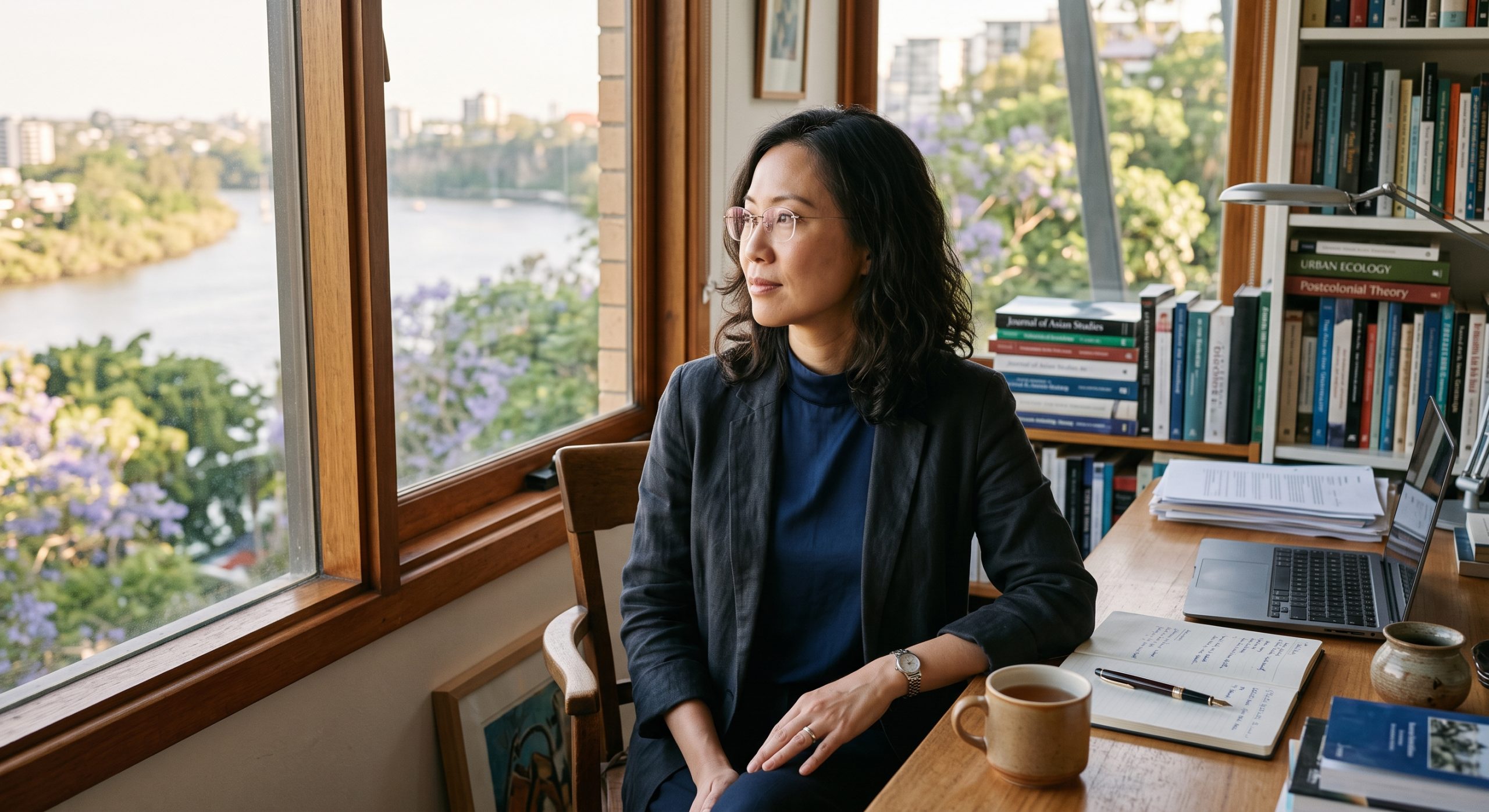
Even now, looking out over the winding Brisbane River from my university office in Queensland, that specific morning symphony remains the sensory baseline of my life. I am a Malaysian-born academic of Chinese heritage, a woman whose intellectual foundation was laid in the crowded suburbs and bustling corridors of Kuala Lumpur before research, scholarships, and career milestones eventually led me across the ocean to Australia. My grandfather arrived in Malaya by steamer from Guangdong, laboring in the tin mines around the Selangor river basin before saving enough to open a small sundry shop along Petaling Street. My parents came of age through the transition of Merdeka and the dark shadow of May 13, 1969. I was raised in a sprawling suburban taman, educated in national vernacular schools, and spent years navigating higher education and university teaching in Malaysia before moving into international academia.
To live in Malaysia as a non-Bumiputera—specifically an ethnic Chinese woman—is to exist inside an intricate, lifelong balancing act. It is to inherit a home you would defend with your life, while navigating a societal framework that permanently delineates who belongs by birthright and who belongs by grace. Observing these dynamics today from an academic desk in Brisbane does not distance me from that reality; if anything, the geographical distance clarifies it. Malaysian multiculturalism is not an abstract civic experiment; it is the concrete pavement beneath our feet, yielding both genuine cultural abundance and structural frictions that shape every phase of our lives.
The Lived Advantages: The Architecture of Everyday Kinship
When Western scholars and foreign observers analyze multiculturalism, they often treat it as a deliberate policy of tolerance—a formal, legal framework designed to minimize social friction. In Kuala Lumpur, tolerance is far too cold and mechanical a word. Our multiculturalism is fundamentally sensory, relational, and deeply woven into our daily survival.
The most visible advantage is our unshakeable, pan-ethnic culinary commonwealth. Food is our primary national language. A Chinese family in KL does not merely eat dim sum or pan mee; we crave fiery nasi lemak wrapped in banana leaves for breakfast, flock to Jalan Ipoh for banana leaf rice at noon, and crowd around mamak stalls under plastic umbrellas late at night watching football over roti canai. Food cuts across communal boundaries faster than any political rhetoric ever could. When a Muslim friend invites you into their home for Hari Raya Aidilfitri, you bring kuih kapit or halal-certified mandarin oranges; when Chinese New Year arrives, you ensure the catering is certified halal so everyone can gather around the yee sang and toss the raw fish together, shouting blessings in unison. This ritual—our tradition of the “Open House”—remains one of the most remarkable social mechanisms any nation has ever devised.
Beyond food, there is the cognitive and linguistic agility forged by living among multiple tongues. Growing up in KL, monolingualism feels like a physical limitation. An ordinary conversation between colleagues or neighbors switches registers three or four times in a single sentence: starting in English, dipping into Malay for administrative clarity, throwing in a Cantonese idiom to convey irony, and borrowing a Tamil descriptor for emotional flavor. In my academic life abroad, this linguistic fluidity has proven invaluable, granting a nuanced ability to read subtext, adapt across varied international contexts, and collaborate with diverse research teams across Asia, Europe, and Australia.
Yet the greatest everyday advantage is an instinctive literacy in other people’s dignity. Growing up, you learn without thinking that your neighbor’s sacred days require consideration. You learn when not to eat openly during Ramadan out of quiet respect; you understand why firecrackers during Deepavali sound different from those at Lunar New Year; you recognize the particular rhythm of wedding drums in a community hall. That literacy creates a warm, resilient neighborhood texture that rarely makes international headlines.
The Disadvantages: The Politics of Difference and the Communal Bubble
However, to romanticize this daily co-existence without addressing its structural flaws would be dishonest. The primary disadvantage of Malaysian multiculturalism is that it has never been allowed to develop into a unified, race-blind civic identity. Instead, it was historically institutionalized along racial lines.
Under the British colonial administration, communities were compartmentalized according to the classic policy of divide and rule: Malays in rural agriculture and administration, Chinese in urban tin mines and trade, and Indians on rubber estates. That spatial and vocational division did not vanish at independence; it was codified and reorganized into modern political reality.
For a Malaysian of Chinese heritage, this institutionalization manifests as an underlying, perpetual sense of conditional citizenship. The affirmative action policies introduced under the New Economic Policy (NEP) after 1969—designed to redress economic imbalances favoring non-Malays—have evolved over half a century into an entrenched system of racial preferences.
The practical impact touches every family milestone:
- Higher Education: Strict university admissions quotas historically forced countless high-achieving non-Bumiputera students out of top public university programs in medicine, engineering, and law, directing them instead toward expensive private universities or driving them abroad.
- Public Sector Representation: The civil service, police, armed forces, and public healthcare administrations remain overwhelmingly dominated by one ethnic group, leaving minorities feeling structurally detached from public governance.
- Housing and Commerce: Mandatory racial quotas and discounts for residential property purchases (Bumi lots) and licensing requirements for government procurement remind you, with bureaucratic indifference, that your tax contributions do not equate to equal status under statutory law.
This institutional division breeds a mirror-image disadvantage within minority communities: insularity. Frustrated by systemic barriers, segments of the Chinese community have historically retreated into their own socio-economic silos. We establish our own independent high schools (Chinese Independent High Schools), fund our own clan associations, patronize our own business networks, and consume media originating from Taiwan, Hong Kong, or mainland China rather than local programming.
When groups retreat into protective enclaves, mutual suspicion easily takes root. In urban areas, you encounter young Chinese professionals whose command of Bahasa Melayu is purely utilitarian, and who know very little about the inner spiritual lives of their Malay-Muslim counterparts beyond the basic rules of halal food. This parallel living means that while our physical lives intersect constantly in shopping malls and on highways, our emotional and political universes often remain separate.
The Core Challenges: Polarisation, Brain Drain, and the Modern Dilemma
This perpetual push-and-pull between street-level solidarity and top-down communal governance generates significant, recurring strains:
- The Everyday Camaraderie vs. Political Pressures: While neighbors share food and navigate multilingual conversations naturally, election cycles routinely weaponize race and religion to consolidate voting blocs, leaving citizens caught between personal goodwill and political polarization.
- The Reality of Parallel Lives: Communities live peacefully side by side, sharing public transit and business districts, yet their daily trajectories remain shaped by separate educational paths, ethnic commercial bubbles, and distinct cultural spheres.
- The Talent Exodus vs. National Renewal: Deep-seated frustrations over unequal opportunity drive educated youth and experienced professionals abroad, complicating the nation’s push to move past the middle-income trap and forcing an ongoing debate about what a unified civic identity—a true Bangsa Malaysia—ought to look like.
1. The Weaponization of Race and Faith
Whenever elections approach, politicians routinely play the communal card to consolidate power. For decades, the dominant political strategy has relied on convincing the majority community that their special position and religion are under existential threat from assertive minorities, while simultaneously warning minorities that their cultural and linguistic rights will be erased if they do not vote defensively.
In recent years, this rhetoric has been compounded by rising religious conservatism. What was once framed primarily as an economic balance has increasingly taken on the language of religious orthodoxy. For the Chinese community—who are predominantly Buddhist, Taoist, or Christian—this shift raises real anxieties about the gradual erosion of the secular legal framework established in the Federal Constitution.
2. The Bleeding of Human Capital (Brain Drain)
Perhaps the most damaging economic and intellectual consequence for the country is the relentless departure of its young talent. Walk into any major research university, hospital, finance hub, or tech firm in Brisbane, Sydney, Melbourne, Singapore, or London, and you will meet talented Malaysians of Chinese and Indian descent.
As someone who made that journey into the Australian academic sector, I know firsthand that we do not leave because we dislike our homeland. Almost every Malaysian living abroad pines for the food, misses their family, and carries an aching nostalgia for the warmth of home. They leave because they hit a glass ceiling of meritocracy. When a bright young student or researcher watches opportunities allocated by ethnic quotas rather than capability and rigor, the psychological contract with the state frays. This brain drain weakens the nation’s capacity to move past the middle-income trap, sapping universities and high-value industries of the very thinkers and builders they need.
3. The National Identity Paradox: What is a “Malaysian”?
We still struggle with the fundamental question: Can one be fully Malaysian without diluting their ethnic identity?
In neighboring countries like Indonesia or Thailand, aggressive assimilation policies historically forced Chinese communities to adopt local surnames and abandon mother-tongue education. Malaysia took a different path, preserving vernacular primary schools (SJKC) and cultural institutions. This allowed us to maintain linguistic mastery and ancestral heritage.
Yet, this dual existence leaves us open to accusations of divided loyalties from conservative nationalists. To this day, one still hears fringe political figures telling minorities to “return to where they came from,” casually ignoring that three, four, or five generations of our ancestors are buried in the red soil of the peninsula.
Walking the Tightrope: A Scholar’s Perspective from Afar
Despite these systemic burdens, if you ask me whether I would trade my Malaysian identity for another, my answer remains an unhesitating no.
There is an enduring resilience in our ordinary citizenry that constantly outshines the cynicism of our politics. You see it during monsoon floods, like the historic inundations that hit the Klang Valley in late 2021. When neighborhoods went underwater, nobody stopped to check the race or religion of the family stranded on the roof. Chinese youth associations brought boats to rescue elderly Malay residents; Sikh gurdwaras prepared thousands of hot vegetarian meals for Muslim families; Malay volunteers cleared out mud-drenched living rooms in Chinese neighborhoods. At ground level, shared vulnerability consistently proves our shared humanity.
Multiculturalism in Malaysia is neither an unblemished triumph nor a failed project. It is a work in progress—a living negotiation conducted daily over dinner tables, office partitions, and train platforms.
For the country to fulfill its promise, the old race-based paradigm must eventually evolve into an equitable, needs-based framework that uplifts the vulnerable regardless of ethnicity, while retaining the deep cultural pluralism that makes the nation extraordinary.
Even as I build my intellectual home here in Brisbane, my sense of self remains anchored in that bustling Klang Valley kitchen table. As a Chinese Malaysian woman, I do not look back across the ocean demanding special privilege; I carry the quiet conviction that the labor, the taxes, the scholarship, and the enduring affection of our communities belong to Malaysia entirely. Until systemic change catches up with social reality, Malaysians will continue doing what they do best: working hard, looking out for their neighbors, critiquing the state over morning coffee, and pulling up a chair to share the table together.